Skateboarding has had video games for forty years.
For a few of those years, there were lots of them. For most of the rest, there were almost none.
This is a short history of how that happened, and where the new ideas come from now.
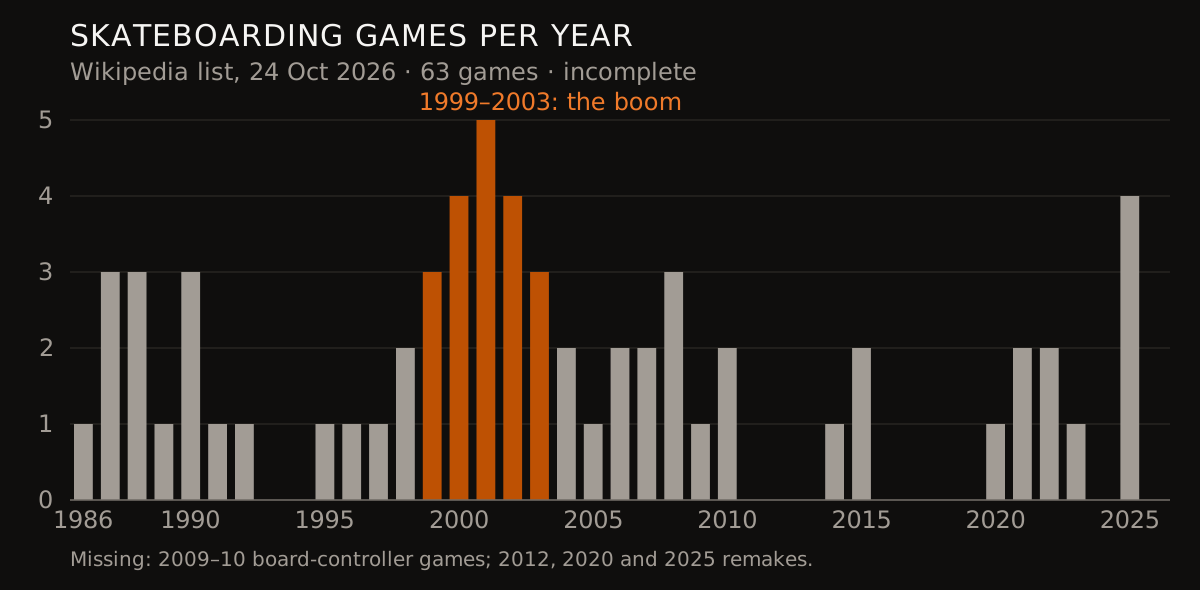
The chart counts full releases on Wikipedia's list, so early access years don't show.
The first wave, 1986 to 1992
The first skateboarding game on most lists is an arcade cabinet, 720°, from Atari Games in 1986. You skated a small town, collected tickets and paid to enter ramp, jump and slalom events.
A year later, home computers had their own. California Games put a half-pipe next to surfing and BMX. Skate or Die! gave skating a whole game to itself.
A handful followed on consoles and handhelds. Then, around 1992, they stopped. Wikipedia's list has nothing for 1993 or 1994.
The boom, 1999 to 2003
Skating came back to TV in the mid-1990s with the X Games, and games followed. Most of them treated the board as one event among many, or as a race.
In 1999, Activision released the first Pro Skater game. It was about tricks and lines, not racing. It sold well, and a sequel came every year until 2007.
Thrasher: Skate and Destroy, the same year, played it slower and closer to real skating.
Others joined. Between 1999 and 2003, at least 19 skateboarding games came out. 2001 alone had five, from a fingerboard game to a city skater from Japan.
You could pick the kind of skating you liked.
A new idea, 2007 to 2010
In 2007, Electronic Arts released skate. It changed the controls. Instead of pressing a button for a trick, you moved the right stick the way your feet move the board: down to load the tail, up to pop.
It felt closer to skating, and it sold. Two sequels followed, in 2009 and 2010.
At the same time, the yearly series tried a plastic board you stood on, in 2009 and 2010. It read your balance with sensors. Reviews called it unreliable.
The long quiet, 2011 to 2019, for the big games
Then the big releases stopped. From 2011 to 2013 the only one was a small HD remake of the first two Pro Skater games, in 2012.
Nobody gives one reason. The ones people point to:
- Yearly sequels wore the formula thin.
- The board-controller games cost a lot and sold few.
- Publishers moved to fewer, bigger series, and skating was not one of them.
Pro Skater 5, in 2015, was widely seen as unfinished.
Players did not move on. People kept playing skate 3 for years, and asked for a skate 4 for most of a decade.
The return, mostly remade
Small studios filled the gap first.
OlliOlli (2014) turned skating into a side-on game of timing. Session started on Kickstarter in 2017 and left early access on 22 September 2022. Skater XL entered early access in December 2018 and launched in full in July 2020. Both give each stick to one foot.
Then the big names came back, but mostly by looking back:
- In 2020, Activision remade its first two Pro Skater games, from 1999 and 2000.
- On 11 July 2025, it remade the third and fourth, from 2001 and 2002.
- On 16 September 2025, EA's skate. returned in early access: free to play, made by a new studio, Full Circle.
Lots of people love them. But the biggest skateboarding releases of 2025 were a remake of games from 2001 and 2002, and the return of a series from 2007.
Meanwhile, Wikipedia's list has four games for 2025, the most since 2002. Most are small. Skate Story, out on 8 December 2025, is a skateboarding game set in the underworld. Games like it exist because a few people wanted a game that didn't exist yet.
Why more than one
Skating is not one thing. It is street, transition and downhill. It is a ledge you have skated for ten years, a curb outside the shop, a line you film on a phone. Some skaters want a score. Some just want to skate.
One game cannot hold all of that. When there is only one, its maker decides how everyone skates: which spots, which tricks, how it plays.
Choice keeps the games honest. A sim pushes the arcade games to feel better. An odd little game shows the big ones what else skating can be.
In 2001 there were five to pick from. In 2025 there were more again, and most of the new ideas came from the small ones.
So play the remakes if you love them. Play the free one. And play the small ones too: they are where the next idea comes from.
Where we fit
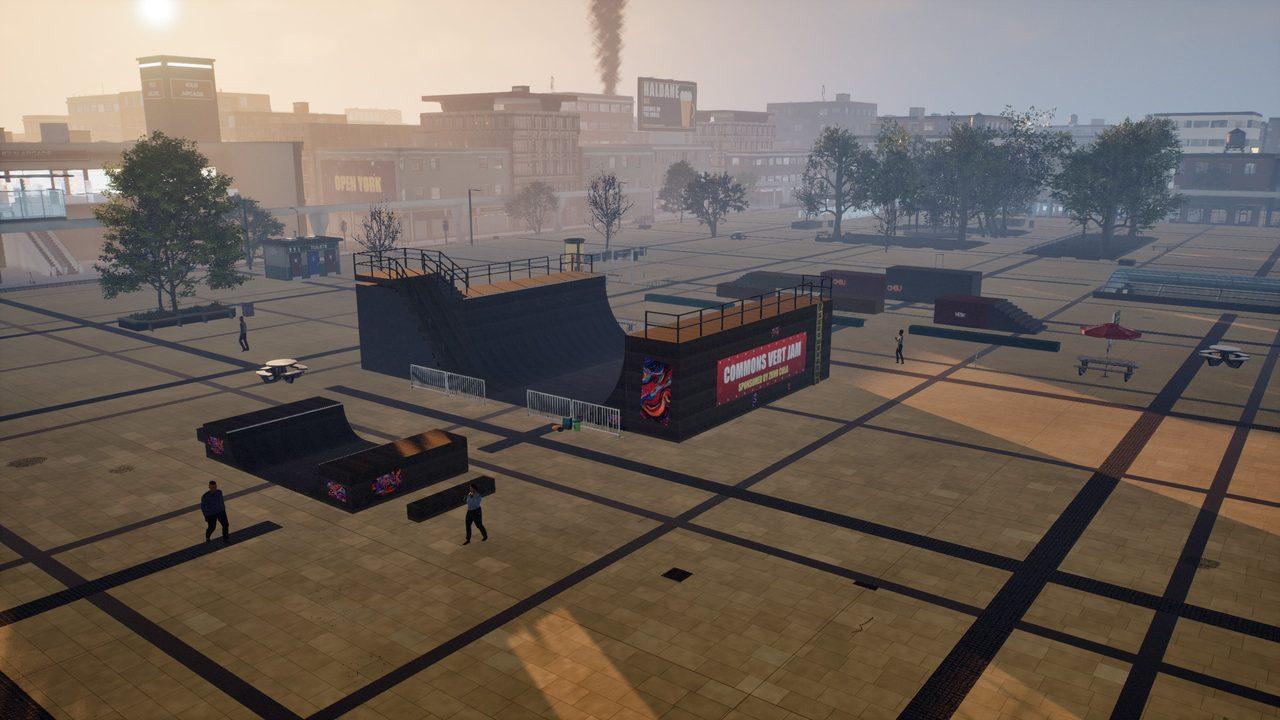
OpenSkate is one small part of that. A city to skate, a board run by physics, and no score. The demo is free on itch.io.
Sources
- List of skateboarding video games, Wikipedia, revision of 24 October 2026. The chart counts its 63 entries by year.
- The History of Skateboard Video Games, Shredz Skateboard Shop, 29 September 2022.
- Session: Skate Sim launches in full on September 22, GamingBolt.
- Skater XL will stick the landing in July, TheSixthAxis, 3 April 2020.
- Activision unveils the third and fourth remakes, Video Games Chronicle.
- skate. is out today in early access, free to play, Push Square, September 2025.
- Skate Story launches December 8, Gematsu, October 2025.
Game names are their owners' trademarks. OpenSkate has no link to any of them.